Skip to content

Compare event interpretation

AI interpretation tools for conferences, compared (2026)

AI interpretation tools for conferences differ in language coverage, attendee access and how they receive speaker audio. This guide helps you choose between venue translation services and built-in meeting features; the vendor facts were checked on 11 October 2026.

Three steps with Baian

  1. 01

    Connect the stage audio

    Plug the sound desk into a laptop by USB, or use an audio interface.

  2. 02

    Open Baian on a laptop or tablet

    Choose your languages and press start.

  3. 03

    Share the QR code

    Attendees scan it and follow on their own phones.

Results

Who shows how accurate they are?

What each service publishes about its accuracy. Checked 15 October 2026.
ServicePublished accuracy evidence
BaianResults on named public tests, with dates and methods. See them ↗
InterprefyIts own private test only (“up to 98%”), scored with its own method. Source ↗
WordlyA 98% to 99% claim with no named test set. Source ↗
KUDOA private May 2023 test that KUDO itself calls out of date. Source ↗
InteractioNo accuracy figures. Source ↗
MaestraNo accuracy figures. Source ↗
TimekettleAn “up to 98%” claim with no named test set. Source ↗
Microsoft Teams InterpreterNo figures; Microsoft says accuracy isn’t guaranteed. Source ↗
All live results

The practical differences

What else should you compare?

Baian: stage audio to attendees’ phone browsers

Baian suits organisers replacing interpreters, booths and receivers. An AV operator sends stage audio to a laptop browser through the mixer’s supported USB audio or a sound card. Attendees open a QR link and choose a language. They read translated text or hear supported audio through their own headphones; no app is needed.

How the live interpreter works at events ↗
Wordly and KUDO: check the language catalogue

Wordly advertises over 60 languages and QR-code or link access without downloads. Check spoken inputs and audience outputs for each language in your programme, including whether attendees can listen or need text.

KUDO’s AI catalogue lists 77 languages across Audio & Captions and Captions-Only modes. Confirm audio for each required language. Its separate human-interpretation service covers 200 spoken and sign languages; specify which service you need when requesting a proposal.

Wordly’s advertised languages and access ↗KUDO’s AI modes and human languages ↗
Interprefy: AI delivery and a human service

Interprefy’s AI Speech Translation page advertises 80+ languages and 6,000+ language pairs, with audio or captions delivered through its mobile app or web platform. Check the route your delegates will use and try it on their intended devices during the event rehearsal.

Interprefy also offers professional interpretation through a network of 6,000+ interpreters. Ask which languages its human service can provide for your programme.

Interprefy’s AI language and delivery options ↗Interprefy’s professional interpreter network ↗
Interactio: mixed delivery and onsite app access

Interactio describes human interpretation and AI translation, including mixed human and AI delivery in one meeting. For a programme where different sessions need different approaches, ask how that combination would work for your speakers and audience.

Its published onsite instructions ask attendees to open the Interactio phone app and enter a meeting code. Include that step in delegate instructions and test it on the phones your audience will bring.

Interactio’s human and AI delivery ↗Interactio’s onsite attendee instructions ↗
Teams and Zoom: speech translation inside meetings

Microsoft Teams Interpreter supplies speech-to-speech interpretation within Teams meetings and calls. It can simulate the speaker’s voice or use an automated voice. For an organisation already running its programme in Teams, assess that meeting workflow before adding a separate venue audience route.

Zoom Voice translator generates synthetic speech from translated spoken content. Its help page requires the Live Translation add-on or ZoomMate and the Windows or macOS desktop app, version 7.0.0 or higher. Check its listed languages before treating it as an audio option for your meeting.

Microsoft: Interpreter in Teams ↗Zoom: Voice translator requirements ↗
Google Meet: one speech-translation pair at a time

Google Meet speech translation supports English paired with French, German, Hindi, Italian, Portuguese or Spanish. Only one pair can be active per meeting, and changing it changes the pair for everyone. The help page gives a 90-minute limit and excludes speech translation from livestreams and recordings.

Google’s April 2026 announcement describes an Android and iOS rollout, while its computer help page still calls phones unsupported, so test speech translation on your own phones.

Google: speech translation languages and limits ↗Google: April 2026 mobile rollout announcement ↗

Customer story · QIYADA, Doha

Two days. One QR code on the stage screen.

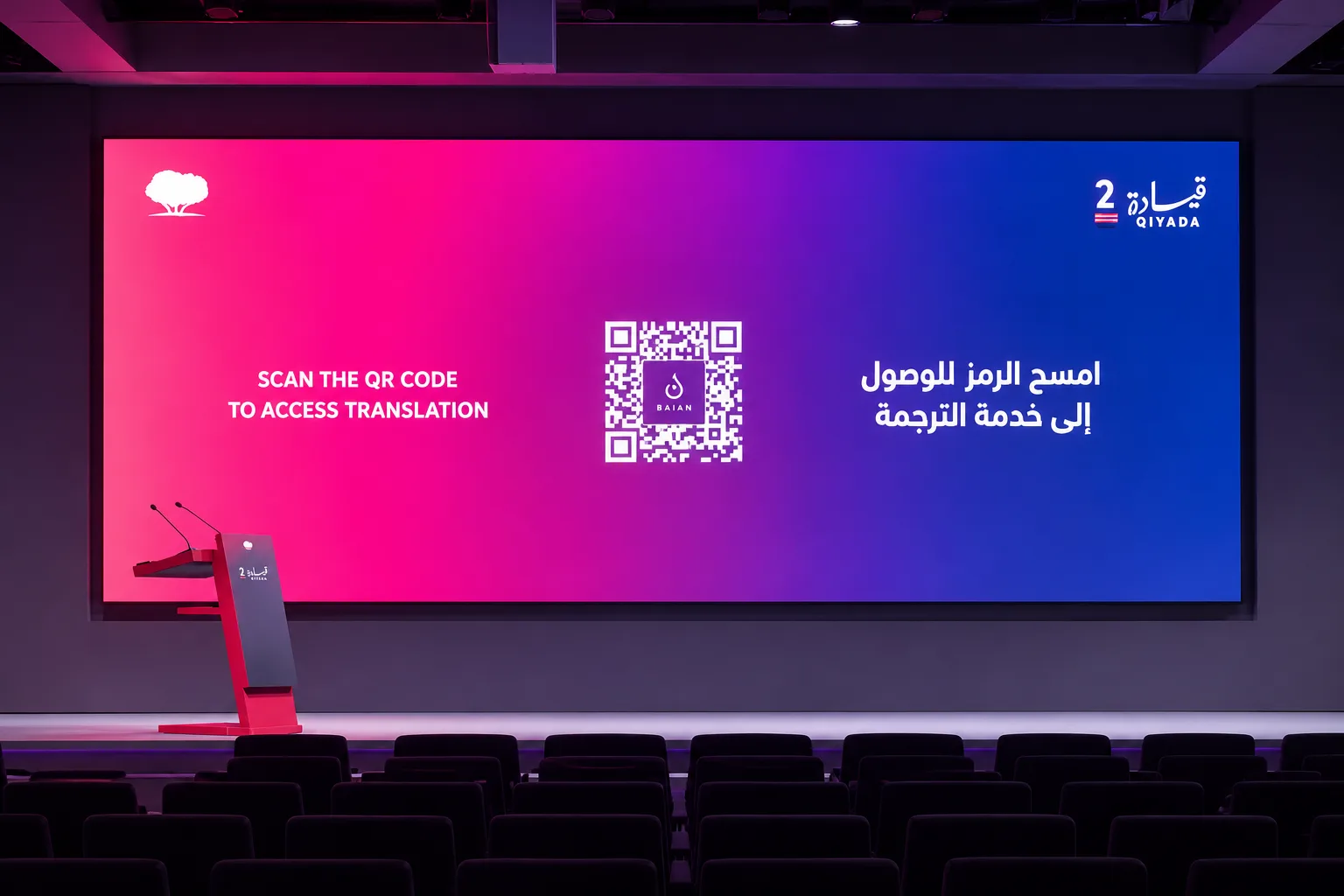
At Qatar Foundation’s QIYADA conference, attendees scanned the code and followed Arabic and English on their own phones. The interpreter booths were taken down.

Dates
25 and 26 Sept 2026
Languages
Arabic, English
Booths
None
Read the story
The QIYADA stage screen showing Baian’s QR code, asking attendees in English and Arabic to scan it for translation

Want to test it with your event?

Tell us your languages, audience size and sound setup. For up to 10,000 listeners at once, we’ll confirm capacity and support before you book.

Discuss your event ↗WhatsApp More comparisons →
Sources and methodsChecked 11 October 2026
  • Live speech recognition (AssemblyAI real-time benchmark)AssemblyAI runs 25 August to 23 September 2026; Baian runs 13 to 15 October 2026

    1st in Arabic (5.1%) and Korean (2.9%), 2nd in Russian and Danish. Fewer errors than all three OpenAI real-time models in 13 of the 14 languages we publish.

  • Baian against professional translators (FLoRes)October 2026

    Caption Tool scored above the translators in Hausa, Swahili, Tamil and Urdu (preferred on 67% to 75% of sentences). Baian’s live interpreter had about the same overall quality in Arabic, Hindi and Korean.

  • Live delay13 to 15 October 2026

    Median 2.1 seconds across 53 recordings in 15 languages (1.3 to 2.7 seconds per recording).

  • European Parliament interpreters2019

    Median 2.69 seconds behind the speaker, across 180 speeches.